Why am I building a SaaS product in the middle of the Great SaaS Meltdown? Fair question.
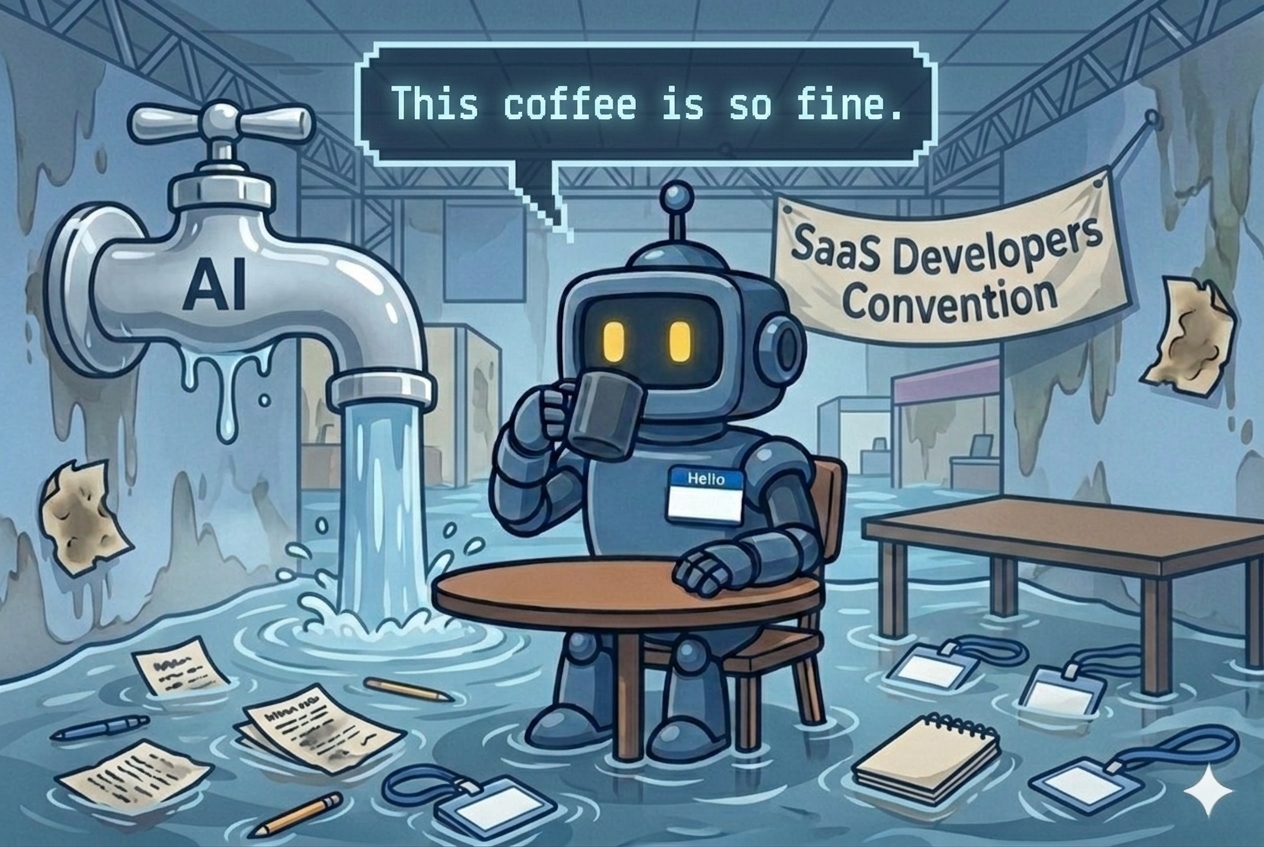
If you follow tech news at all, you'll know some or all of the following: AI is eating SaaS. Agents will replace your app. Users won't need UIs anymore. Your beautiful dashboard is about to become a JSON endpoint.
Set your AI voice to Ralphie and type in "Brush up on those barista skills, indie devvvvvv."
And look, some of that is probably true. For a lot of products, the value was always in the data or the domain logic, not in the screen with the swank color palette. If an agent can make the same decision faster, the screen may eventually go away. (Check out the latest Bankless podcast with some wild thoughts about that phenomena in the world of crypto and UI : Haseeb Quereshi: Crypto's Not Made for Humans—It's for AI)
So why is yours truly building Validibot, a data validation platform, right now, in the middle of all this?
I'm a crap barista, but that's not why.
Rather, it's because, in the fields I find most interesting ( energy modelling, scientific computing, energy transition, etc. etc. ) a bad model or an unchecked assumption can waste months of work, misdirect funding, or quietly undermine trust in results that actually matter. And I think AI makes that problem worse, not better. Here's the thing nobody seems to be talking about: AI is generating your data now? So who's checking it?
The Checking Problem
When a human engineer works with an energy model manually, they're implicitly validating as they go. They know that a wall U-value of 47 W/m²K is nonsense (shush, passive house people). They know they can't have surfaces assigned to the wrong boundary conditions or duplicate vertices. They catch things because they have years of domain expertise baked in.
An LLM has statistical patterns and vibes. Lots of vibes.
No doubt AI tools generate amazing things, but they can add small bits of strange data with absolute confidence. And the volume of generated data is only going up. In fact, I think the volume of generated data is about to dramatically outpace our ability to manually review it. When it was just humans submitting files, you could maybe get away with spot-checking. When it's agents submitting hundreds of files a day? You need the checking to be as tireless as the generation.
Where Validibot Fits
This is where I think Validibot becomes genuinely useful. Not as a replacement for AI and not as some generic data pipeline tool either. It's a focused guardrail that sits alongside the things generating your data.
The idea is pretty simple. You define validation workflows that encode your domain expertise: what "good" looks like for your data. Schema checks. Range assertions. CEL rules that capture the stuff a seasoned professional would spot by eye. Maybe even a simulation step that runs the data through a simulation engine to see if the outputs make physical sense.
Then you let anything — a person (your user), an API client, an AI agent — submit data to that workflow. Valid data gets a green checkmark. Invalid data gets a detailed report of exactly what's wrong and why. No human reviewer needed in the loop. The domain expertise lives in the workflow itself.
In a world where AI is producing data at scale, automated validation isn't a nice-to-have. It's the only way to maintain trust in your data pipeline.
Making It Agent-Friendly
Here's the part I'm most excited about right now. If AI agents are going to be generating and submitting data, then the validation system needs to speak their language. You can't exactly ask an agent to squint at a web form and click "Upload."
(Yes, ok I'm sure you probably can now, but give my metaphor for now.)
So I'm working on an MCP (Model Context Protocol) interface for Validibot. MCP is an open standard that lets AI agents discover and interact with external tools in a structured way. With an MCP interface, an agent can discover available validation workflows, submit data for validation, get structured results back, and act on them, all without a human touching anything.
Example scenario: an AI agent generates a building energy model, submits it to a Validibot workflow via MCP, gets back a report saying "energy use intensity per m2 is outside our acceptable range for this climate zone," fixes the model, resubmits, and gets the green checkmark. All autonomously. All before a human even knows it happened.
That's the idea, anyway. I'm working on it. Please share you thoughts if this all sounds interesting. Get in touch. or comment on the Validibot Github Repo. And please give me a star when you do. I'm as shameless as a YouTuber.
It's Not Just About AI, Though
To be clear, you don't need AI in your pipeline for Validibot to be useful. If you've got users submitting data that needs to be checked -- stuff like manufacturing specs, simulation files, compliance documents, whatever -- the value proposition is the same: encode your expertise into a workflow, let your users (human or otherwise) self-serve, and get yourself out of the review loop.
The AI angle does make it more urgent. When it was just humans submitting data, you could maybe get away with spot-checking things manually. When it's agents submitting hundreds of files a day? You need automation. You need rules. You need the validation to be as fast and tireless as the generation.
What's Next
The MCP work is still early. I'm also continuing to research and build out specialized validators for things like THERM files, EnergyPlus models, and FMUs. The goal is to make it dead simple to set up robust validation for domain-specific data. The kind of stuff where generic JSON schema checks aren't enough and you need real domain logic in the mix.
I'd genuinely love to hear about your use case. I'll repeat the contact link one more time here because you know you want to share: get in touch. Even if it's just to tell me I'm overthinking this. Especially then, actually.